

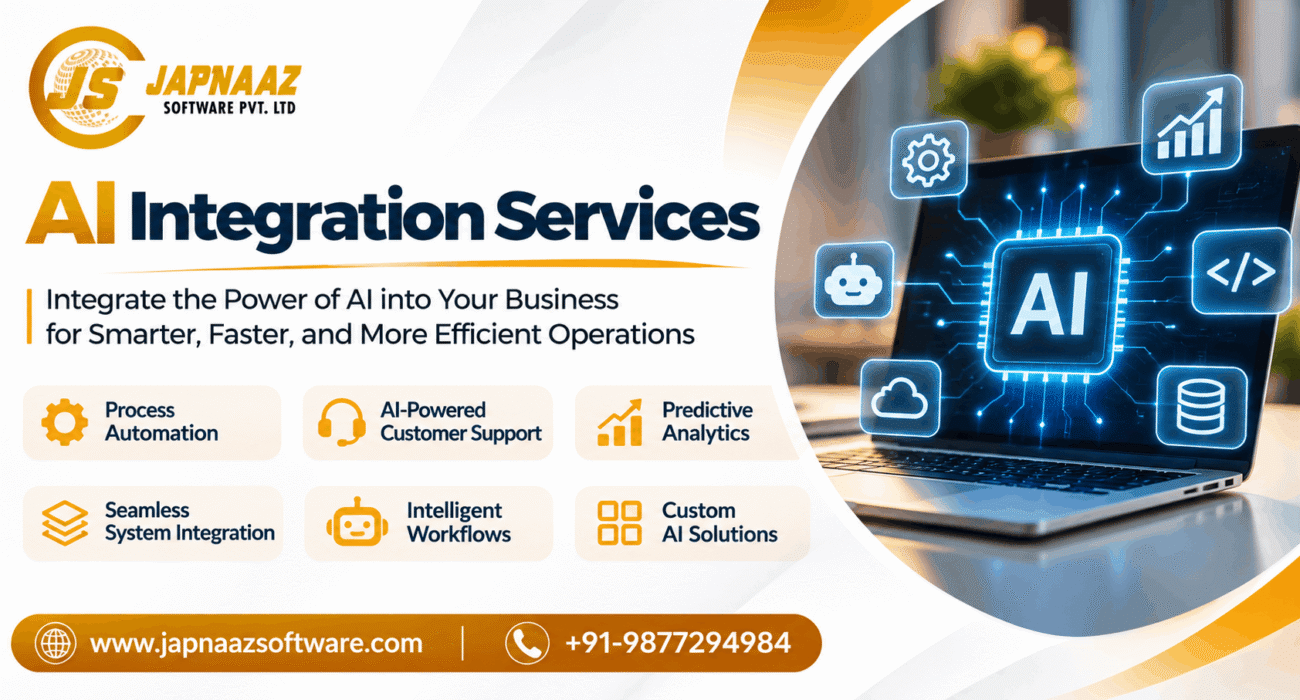
In the rapidly evolving digital landscape of today, companies continually seek more intelligent methods to operate, enhance efficiency, and provide superior customer experiences. Artificial intelligence (AI) has emerged as a key component of this change. By automating routine tasks and assessing customer behavior, AI assists businesses in improving decision-making and operating more effectively. AI Integration Services enable companies to merge advanced AI technologies with their current systems, developing effective and smart solutions that promote sustained growth.
What Are AI Integration Services?
AI Integration Services entail embedding artificial intelligence technologies into current business applications, software platforms, and workflows. These services assist businesses in utilizing AI technologies like machine learning, natural language processing, predictive analytics, and automation driven by AI to enhance their operations.
A company might incorporate an AI chatbot on its site to respond to customer inquiries automatically. An additional company could employ AI to examine sales information, forecast client demand, or streamline routine administrative duties.
The primary aim is to accelerate business processes, enhance accuracy, and improve convenience. Rather than replacing all current systems, AI integration aims to enhance the technology that a business currently utilizes.
Why Modern Businesses Need AI Integration
Contemporary businesses encounter numerous challenges, such as heightened competition, escalating operational expenses, customer demands, and vast quantities of data. Handling these difficulties by hand can drain important time and resources.
AI Integration Services offer a valuable solution to these challenges by implementing smart automation and decisions informed by data.
Here are several key reasons for the adoption of AI by businesses:
- Enhanced efficiency: AI takes over routine tasks, enabling workers to concentrate on key duties.
- Enhanced customer satisfaction: AI-driven chatbots and virtual assistants offer rapid replies and tailored assistance.
- Lowered operational expenses: Automation can lessen manual effort and enhance resource efficiency.
- Quicker decision-making: AI examines extensive datasets and uncovers valuable insights.
- Business scalability: Smart systems enable companies to manage growing workloads as they expand.
Through the use of AI technology, organizations can establish more adaptable and effective business settings.
Key AI Technologies Used in Business Integration
Artificial intelligence encompasses various technologies that can be incorporated into business processes. Every technology fulfills a distinct function based on the company’s objectives and needs.
1. Machine Learning
Machine learning allows computer systems to learn from data and recognize patterns without needing explicit programming for each scenario.
Companies can utilize machine learning for segmenting customers, identifying fraud, predicting sales, and creating recommendation systems. An e-commerce business can examine past purchases to suggest appropriate products to consumers.
2. Natural Language Processing
Natural Language Processing (NLP) enables AI systems to comprehend, analyze, and react to human language.
It is frequently utilized in chatbots, customer service platforms, email automation, sentiment evaluation, and document handling. NLP enables companies to interact with clients more naturally and effectively.
3. AI-Powered Automation
AI automation integrates artificial intelligence with workflow automation to handle repetitive business tasks.
Instances encompass handling invoices, arranging client details, producing reports, overseeing email replies, and refreshing CRM entries.
These automated systems assist workers in conserving time and minimizing the chances of human mistakes.
4. Predictive Analytics
Predictive analytics employs past data, statistical methods, and machine learning to forecast upcoming results.
Companies can leverage this technology to predict sales, detect possible customer turnover, analyze market trends, and enhance inventory control.
How AI Integration Services Improve Business Operations
Incorporating artificial intelligence into business processes can lead to significant enhancements across various departments.
Marketing and Sales
Marketing teams can leverage AI to study customer behavior, recognize potential leads, tailor campaigns, and enhance advertising approaches.
AI tools can assist sales teams in ranking leads according to their probability of becoming customers. This enables companies to concentrate their resources on prospects that could yield improved outcomes.
Customer Support
Customer support is a prevalent field where companies implement AI technology.
AI chatbots can respond to common inquiries, offer product details, help with booking appointments, and walk users through typical problems.
If a question demands human knowledge, the chatbot can hand off the chat to a support agent. This method enhances response times while preserving a personal connection.
Finance and Accounting
Finance teams frequently handle substantial data sets and routine responsibilities.
AI can aid in processing invoices, categorizing expenses, generating financial reports, detecting fraud, and analyzing transactions. These features assist businesses in streamlining their financial processes more effectively.
Human Resources
HR departments can utilize AI to optimize hiring, oversee employee data, coordinate training initiatives, and address routine employee inquiries.
An AI-driven recruitment system can assist in filtering applications according to job-specific criteria. Human recruiters can concentrate on assessing candidates and making final hiring choices.
Benefits of Custom AI Integration Solutions
Each company has distinct objectives, processes, and technological needs. A remedy that functions effectively for one organization might not be appropriate for another.
Tailored AI Integration Services assist businesses in creating solutions tailored to their unique operational requirements.
A few significant advantages consist of:
- Flawless integration of systems: AI can link with CRM systems, ERP applications, websites, and internal tools.
- Customized automation: Companies can streamline workflows tailored to their specific processes.
- Improved data usage: AI assists companies in deriving valuable insights from existing data.
- Enhanced precision: Automated systems can minimize mistakes in repetitive tasks when adequately set up and overseen.
- Adaptable growth: Companies can enhance their AI functionalities as their needs evolve.
Custom integration enables organizations to prevent unwarranted technology alterations by leveraging their current infrastructure.
Challenges Businesses Should Consider Before AI Integration
While artificial intelligence provides many benefits, its implementation necessitates meticulous planning.
A frequent issue is the quality of data. AI systems rely on accurate and pertinent data to generate valuable outcomes. Insufficient or erroneous data can result in unfavorable results.
Another vital aspect is data protection. Companies must safeguard customer data, implement suitable access restrictions, and adhere to relevant privacy laws.
The complexity of integration can pose a challenge when businesses utilize numerous software platforms. When implementing, factors such as compatibility, system efficiency, and upkeep must be taken into account.
Companies ought to provide appropriate training for their staff. When team members grasp how AI tools function, they can utilize them more efficiently and with greater confidence.
Beginning with a simple project, evaluating its performance, and slowly scaling up the implementation is frequently a sensible strategy.
The Future of AI in Modern Business Solutions
Artificial intelligence is constantly advancing, and its significance in business functions is anticipated to grow more substantial.
Businesses are investigating AI-driven agents, smart workflow automation, sophisticated analytics, dialogue interfaces, and tailored digital experiences.
AI agents can aid in handling multi-step processes, like gathering data, creating reports, refreshing business systems, and supporting customer inquiries. Nonetheless, significant decisions must still involve suitable human supervision.
Companies that strategically invest in AI can enhance operational efficiency, respond to evolving customer demands, and create more innovative offerings.
The future is not just focused on employing AI technology. It involves using it to address actual business challenges in a thoughtful and impactful manner.
Conclusion
Artificial intelligence is changing the way contemporary companies function, interact, and expand. From streamlining repetitive tasks to enhancing customer interaction and interpreting business data, AI presents significant opportunities for organizations in various sectors.
By employing an effective strategy, AI Integration Services can assist companies in linking current technologies, optimizing workflows, and developing more intelligent digital solutions. Businesses need to concentrate on recognizing their operational difficulties, choosing appropriate AI technologies, and executing solutions that provide quantifiable benefits.
Companies aiming to enhance their digital processes and integrate smart technologies can investigate tailored AI solutions from Japnaaz Software to aid their business objectives and future development.