

In the competitive realm of online retail, drawing visitors to an e-commerce site is merely part of the journey. The actual difficulty lies in converting those visitors into paying clients. Even if customers discover products they adore, they might depart without finalizing their purchases if the checkout procedure is perplexing, sluggish, or complex.
E-commerce Checkout Optimization is essential for businesses aiming to enhance the online shopping experience and boost the number of completed orders. By streamlining checkout processes, providing user-friendly payment options, and fostering customer confidence, online retailers can facilitate purchases and minimize avoidable obstacles. A seamless checkout process aids both customers and companies by enabling buyers to finalize their purchases with assurance.
What Is E-commerce Checkout Optimization?
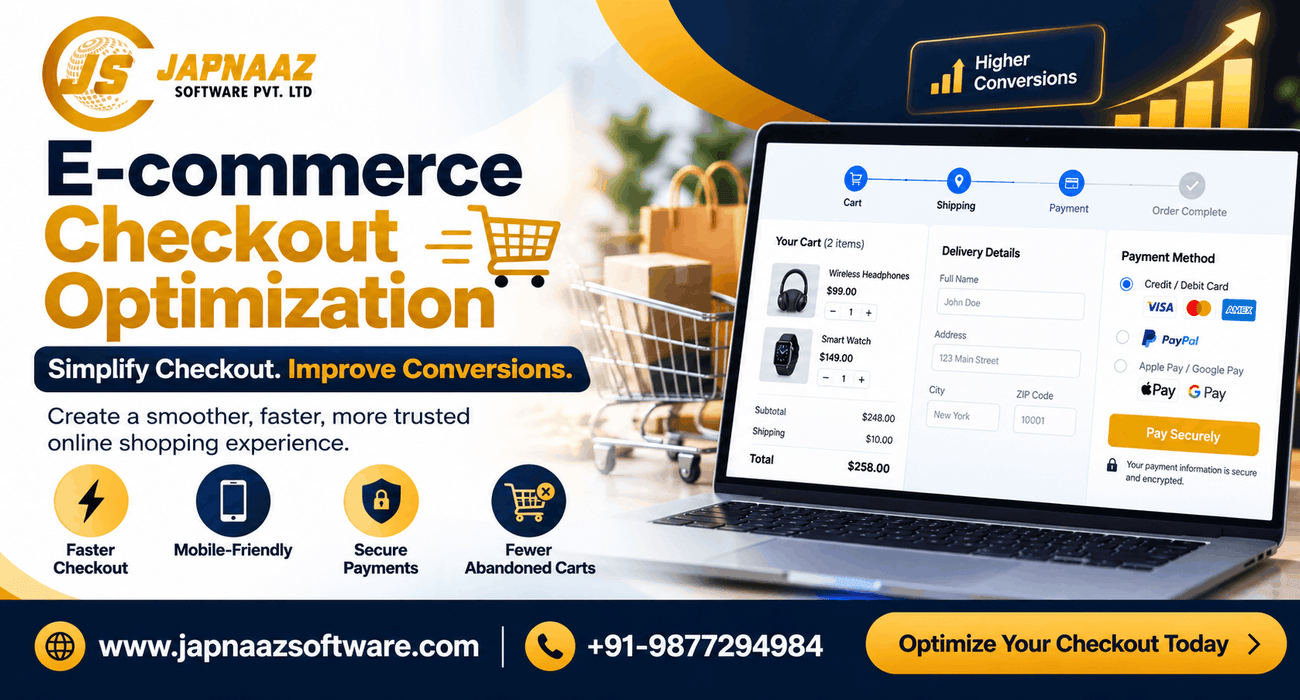
E-commerce checkout enhancement involves refining the concluding steps of an online transaction. It emphasizes simplifying the process for customers to assess their orders, provide delivery details, select payment options, and finalize purchases.
A checkout page must offer straightforward instructions, show the total amount, and lead customers step-by-step without any unnecessary interruptions. When customers face surprise charges, unclear forms, or issues with payment, they might choose to stop.
Successful e-commerce checkout enhancement requires pinpointing these issues and implementing actionable changes based on consumer behavior, site analytics, and usability assessments. The aim is to develop a checkout process that appears straightforward, safe, and trustworthy on both desktop computers and mobile devices.
Why Checkout Optimization Matters for Online Businesses
An efficiently crafted checkout procedure can enhance customer experiences and assist businesses in optimizing their website traffic.
1. Reduce Cart Abandonment
Cart abandonment happens when customers place items in their carts but exit without finalizing their transactions. Frequent causes consist of unanticipated shipping fees, required account registration, restricted payment methods, and extended checkout processes.
Companies can tackle these challenges by showing prices upfront, providing guest checkout options, and eliminating unnecessary steps. Providing clear delivery details and transparent return policies can enhance customers’ confidence in finalizing a purchase.
2. Improve Customer Experience
Shoppers anticipate that internet shopping will be easy. If the checkout page is confusing to use or requests irrelevant details, customers might feel annoyed.
An uncomplicated design, legible labels, unambiguous error messages, and a noticeable order summary enhance comprehension of the process. Effective checkout design should seamlessly lead customers from examining their cart to obtaining their order confirmation.
3. Increase Purchase Conversions
A conversion takes place when a visitor fulfills a targeted action, like buying a product. Enhancing the checkout process can eliminate barriers that stop customers from finalizing their purchases.
While enhancements to the checkout process may not assure increased sales, addressing and resolving usability issues can assist companies in converting a greater portion of their current traffic into finalized purchases.
7 Effective E-commerce Checkout Optimization Strategies
Companies can enhance their checkout experience by concentrating on these strategies.
1. Simplify the Checkout Process
A complex checkout process may deter customers from finalizing a purchase. Requesting customers to navigate multiple pages or supply superfluous information adds extra resistance.
Make the process as brief as possible. Gather only the data required to fulfill the order, deliver the item, and offer necessary customer assistance.
An online apparel retailer might require a shipping address, contact information, and payment details. Typically, it doesn’t require customers to fill out extensive preference questionnaires at checkout.
Optimizing E-commerce checkout effectively begins by eliminating superfluous steps while maintaining crucial information and security protocols.
2. Offer Guest Checkout
Not every buyer wishes to set up an account prior to completing a purchase. Certain customers might be purchasing for the first time or just favor a faster transaction.
Allowing guest checkout enables customers to finalize a purchase without having to set up a lasting account. Companies may offer a voluntary account setup process following the completion of the purchase.
This method provides consumers increased flexibility and can enhance the purchasing experience. Customers returning can still take advantage of saved addresses and account features upon choosing to register.
3. Make the Checkout Mobile-Friendly
A lot of shoppers explore and buy items via their smartphones. A checkout page that is effective on a desktop may be challenging to navigate on a smaller device.
Employ adaptable layouts, legible text, suitably sized buttons, and user-friendly forms that are simple to fill out on mobile devices. Make sure that the payment fields, delivery choices, and order summaries are easily accessible without too much scrolling.
Mobile checkout testing must encompass various screen dimensions, browsers, and payment options. Companies ought to enhance page speed since sluggish checkout pages can disrupt the buying process.
4. Provide Multiple Payment Options
Payment preferences among customers vary based on their location, purchasing behaviors, and the banking services accessible to them.
E-commerce websites could gain from providing suitable alternatives like credit cards, debit cards, digital wallets, and locally favored payment options. The options provided must align with the intended audience and the payment processing capabilities of the store.
Clearly present accepted payment options and outline any limitations prior to customers completing the final payment stage.
An effective payment process is essential for E-commerce Checkout Optimization, as payment issues or restricted options can stop interested customers from finalizing their purchases.
5. Display All Costs Clearly
Unforeseen expenses often lead to frustration at the time of checkout. Shoppers may rethink their buying decisions when shipping costs, taxes, or extra fees emerge unexpectedly.
Display product prices, estimated shipping fees, applicable taxes, and any other necessary charges at the earliest opportunity. If delivery charges vary by location, offer a method to compute them prior to the final payment stage.
Transparent pricing enables consumers to make educated choices and minimizes unexpected outcomes. If complimentary shipping is offered on orders exceeding a certain amount, clarify the requirements clearly.
Clarity fosters trust and aids customers in comprehending precisely what they will be charged.
6. Build Trust and Communicate Security
Clients require assurance that their private data and payment information are managed correctly. A checkout page that is unfamiliar or poorly designed can raise uncertainties, especially for new customers.
Utilize HTTPS, a trusted payment processor, transparent privacy details, and familiar payment choices. Show pertinent delivery, refund, and return policies in a location that’s easily accessible for customers.
Steer clear of irrelevant pop-ups and deceptive countdowns that generate stress without offering real benefits. Trust should arise from clear policies, dependable technology, and steady communication.
7. Test and Improve Checkout Performance
Optimizing the checkout process should be a continuous effort instead of a single design modification. Customer expectations, website features, and payment technologies may evolve over time.
Utilize analytics to pinpoint where customers exit the checkout process. Track checkout initiations, completed transactions, payment errors, form issues, and conversion rates by device type.
A/B testing can evaluate various layouts, button texts, form structures, or positions of delivery details. Alter one significant factor at a time when feasible, and assess outcomes using adequate data instead of depending on assumptions.
Common Checkout Mistakes Businesses Should Avoid
Even appealing online shops can miss out on sales due to preventable checkout issues.
Frequent errors consist of:
- Mandating account creation prior to making a purchase.
- Displaying shipping fees too late.
- Requesting superfluous client details.
- Employing unclear payment or shipping guidelines.
- Supplying vague error notifications when forms lack completeness.
- Disregarding mobile compatibility and website load time.
- Neglecting to verify payment options following website changes.
- Hiding the final purchase button from an easy view.
Consistent evaluations assist companies in identifying these problems prior to them impacting a significant number of clients. Addressing the most critical issues first can lead to a more effective enhancement strategy than completely overhauling the checkout process without justification.
How to Measure Checkout Optimization Results
To determine if changes are effective, companies need to set a baseline prior to making enhancements.
Key indicators consist of:
- Checkout completion ratio: The proportion of checkout sessions that lead to a successful purchase.
- Cart abandonment rate: The proportion of shopping carts that fail to lead to a purchase, employing a uniform measurement approach.
- Rate of payment failures: The percentage of payment attempts that are unsuccessful.
- Mean order value: The typical income produced from each finalized order.
- Mobile conversion rate: The proportion of mobile users who finalize a purchase.
Examine these metrics in conjunction with traffic origins, product types, and customer devices. A high rate of payment failures might suggest an issue with the gateway, whereas a notable increase in mobile abandonment could highlight usability or performance concerns.
E-commerce Checkout Optimization aims to simplify the buying process while evaluating if modifications enhance significant business results.
Final Thoughts
An efficient checkout process is a crucial aspect of a thriving online shop. By streamlining forms, providing guest checkout, accepting relevant payment options, showing clear pricing, and enhancing mobile usability, companies can eliminate typical obstacles to buying.
Regular testing and performance evaluation assist in recognizing customer requirements and determining which enhancements provide tangible benefits. Investing in E-commerce Checkout Optimization allows online businesses to enhance the shopping experience and maximize their current website traffic effectively.
By implementing a pragmatic approach centered on usability, efficiency, and customer confidence, Japnaaz Software assists businesses in identifying website enhancements that foster improved e-commerce experiences and sustainable online development.