

In the rapid-paced digital landscape of today, companies are always seeking methods to save time, enhance productivity, and handle daily responsibilities more effectively. From addressing customer inquiries to maintaining records and generating reports, staff frequently dedicate a considerable amount of time to routine tasks. These responsibilities are crucial, yet they may diminish the time left for strategic planning, customer relations, and business growth.
This is the point at which AI Workflow Automation Services can truly impact. Integrating artificial intelligence with automated business processes allows companies to minimize manual tasks, link various applications, and establish more efficient workflows. Regardless of whether a business is a startup, a developing firm, or a well-established entity, automation driven by AI can streamline daily activities and foster sustainable growth.
What Are AI Workflow Automation Services?
AI workflow automation employs artificial intelligence and automation technologies to handle repetitive tasks, manage data, and synchronize business operations with reduced manual involvement. Conventional automation typically adheres to established rules, whereas AI is capable of understanding text, categorizing data, condensing documents, and producing replies.
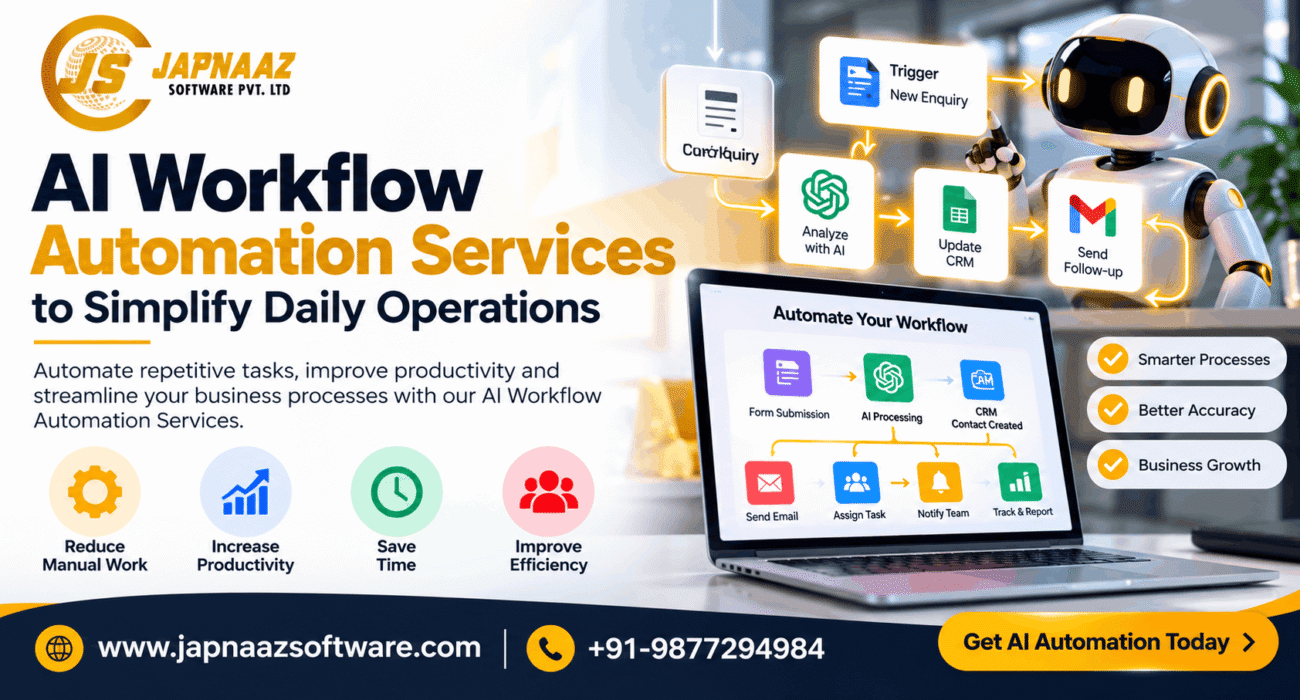
For instance, when a client sends a query via a website, an automated process can gather the details, generate a record in a customer relationship management (CRM) system, classify the inquiry, and alert the relevant sales representative.
Professional AI Workflow Automation Services assist companies in recognizing appropriate processes for automation and integrating the tools they currently use. The goal is to enhance daily operations, minimize avoidable hold-ups, and enable staff to concentrate on activities needing human decision-making.
Why Businesses Need AI Workflow Automation
Numerous businesses depend on various applications to oversee their daily operations. They might utilize distinct tools for email, client management, marketing, accounting, project monitoring, and communication. If these systems do not integrate, workers might have to manually duplicate information or redo similar tasks on various platforms.
Automation can decrease this burden and enhance the consistency of business operations.
1. Save Time on Repetitive Tasks
Repetitive activities like inputting customer information, organizing emails, booking appointments, and generating regular reports can take up precious work time.
Workflows enhanced by AI can automatically carry out numerous tasks. For instance, a system can gather data from a form, arrange it into the proper fields, and transmit it to the relevant application.
By minimizing repetitive tasks, employees can allocate more time to problem-solving, assisting customers, and creating new business prospects.
2. Reduce Human Errors
Entering data manually and managing repetitive information can result in overlooked details, inaccurate records, and inconsistent updates. Such errors may lead to extra tasks and influence business choices.
Automation minimizes these errors by utilizing set rules, verifying necessary fields, and normalizing regular procedures. AI is capable of recognizing abnormal data and marking it for evaluation.
Nonetheless, automated systems are not entirely free of errors. Significant financial dealings, confidential customer data, and impactful business choices must incorporate suitable verification and authorization processes.
3. Improve Team Productivity
When workers must transition between applications or await details from other teams, productivity can decrease. Automated processes can transfer tasks across systems and alert the appropriate individuals when action is needed.
For example, once a new project gets approved, a workflow might generate a project management task, allocate responsibilities, alert the team, and set a reminder for a follow-up.
These enhancements assist teams in aligning their efforts and achieving improved oversight of current tasks.
Common Business Processes That Can Be Automated
Automation driven by AI can assist various departments based on their needs and current software.
Customer Support Automation
Support teams often encounter repetitive inquiries regarding services, pricing, account access, and troubleshooting. Manually managing each inquiry can lead to longer response times, particularly during peak times.
AI chatbots and automated systems can address typical inquiries with authorized information, categorize incoming requests, and direct complicated matters to the right support agent.
A chatbot could determine if a customer requires billing help or technical assistance prior to generating a ticket for the appropriate department.
This method can enhance response efficiency, enabling human agents to concentrate on intricate customer issues.
Sales and Lead Management
Sales teams must gather leads, refresh CRM records, arrange follow-ups, and track prospective opportunities. Managing these activities can become challenging when inquiries come in through various channels.
AI Workflow Automation Services assist businesses in gathering leads from site forms, organizing inquiries, outlining customer needs, and delegating follow-up actions.
A business might also streamline internal alerts when a critical lead is received, assisting the sales team in responding more quickly.
The outcome is a streamlined lead management system with reduced manual interventions.
Marketing Workflow Automation
Marketing teams oversee content schedules, email initiatives, target audiences, campaign analysis, and customer interactions. Numerous activities include transferring information across various tools.
AI can help with creating content, summarizing campaign outcomes, classifying leads, and generating email alternatives for evaluation. Automation platforms can subsequently transfer approved content through the designated workflow.
For instance, when a user obtains a guide from a site, the system might include the contact in a pertinent audience segment and start a suitable follow-up email series.
Human oversight is essential to guarantee that marketing messages are precise, pertinent, and aligned with the brand.
Document Processing and Reporting
Companies commonly manage invoices, requests, agreements, documents, and internal reports. Retrieving data from these documents by hand can be time-consuming.
AI tools can gather pertinent information, condense document contents, and arrange data for additional handling. Automated processes can subsequently transmit the extracted information to business systems or direct documents for authorization.
An invoice process might recognize the supplier’s name, invoice number, and total sum prior to forwarding the details to an employee for confirmation.
This can enhance document management efficiency while maintaining suitable financial oversight.
Essential Tools for AI Workflow Automation
Effective automation frequently relies on selecting the appropriate mix of tools.
- AI systems: Extensive language models assist in interpreting text, summarizing details, categorizing inquiries, and creating initial replies.
- Workflow automation solutions: Services like Zapier, Make, and n8n can link applications and manage complex tasks.
- CRM platforms: Customer relationship tools assist in organizing contacts, monitoring sales prospects, and handling follow-ups.
- APIs and integrations: APIs enable various software applications to share data and initiate actions.
- Analytics tools: Reporting systems assist companies in tracking workflow efficiency and pinpointing opportunities for enhancement.
Not all companies require an intricate AI system. In certain instances, a straightforward rule-based process might address the issue more dependably and at a reduced expense. The appropriate solution relies on the assignment, accessible data, financial constraints, and security needs.
How to Implement AI Workflow Automation Successfully
To implement automation, one must have a clear grasp of current business processes. Adopting a systematic method can assist businesses in steering clear of excessive complexity.
Step 1: Identify Time-Consuming Tasks
Begin by pinpointing tasks that workers perform daily or weekly. Identify tasks that require repetitive data input, regular alerts, standard reporting, or moving data between different applications.
Focus on tasks that are straightforward to quantify and offer a distinct advantage to the business.
Step 2: Map the Current Workflow
Record every phase of the procedure, noting who carries out the task, which applications are used, and where hold-ups take place.
This facilitates the recognition of redundant steps and helps determine which tasks can be automated securely.
Step 3: Select the Right Automation Tools
Select tools that work with your current systems and meet your business needs. Take into account implementation expenses, subscription charges, data confidentiality, access rights, and continual upkeep.
An effectively designed workflow ought to align with the business instead of requiring employees to alter all current processes.
Step 4: Test the Workflow
Test automation with a restricted range of tasks before implementing it organization-wide. Verify that data is transmitted accurately, alerts go to the correct individuals, and mistakes are addressed properly.
Maintain human oversight for significant choices and delicate procedures.
Step 5: Monitor and Improve Performance
Upon implementation, evaluate the saved time, frequency of errors, processing expenses, and level of manual intervention needed.
Frequent evaluations assist companies in recognizing issues and enhancing their processes as their requirements evolve.
Benefits of Choosing Professional Automation Services
Creating dependable workflows may necessitate proficiency in software integrations, AI technologies, process architecture, and data safety. Collaborating with a seasoned technology partner enables businesses to pinpoint the most valuable opportunities and deploy appropriate solutions.
AI Workflow Automation Services can feature workflow assessment, automation planning, AI incorporation, application linking, testing, and continuous improvement.
A systematic method aids organizations in defining roles, implementing suitable security measures, and creating processes for managing unforeseen mistakes.
Instead of automating all tasks simultaneously, businesses should start with a feasible project, assess its outcomes, and slowly scale up when the advantages are evident.
Final Thoughts
Streamlining everyday processes is a crucial move for creating a more efficient and scalable enterprise. AI-driven automation can minimize repetitive tasks and enable teams to utilize their time more efficiently across customer support, lead management, marketing, and document processing.
Investing in AI Workflow Automation Services allows businesses to link their applications, enhance process uniformity, and develop more efficient working methods. By employing an effective strategy, appropriate protections, and consistent performance assessments, Japnaaz Software can assist businesses in discovering viable automation solutions that promote more intelligent operations and lasting digital expansion.